 by
by Choosing the right credit card or bank account in India can be confusing. There are hundreds of options, and every bank highlights different benefits such as cashback, reward points, airport lounge access, low fees, high savings interest, or special offers.
But the card or account with the biggest advertised benefit is not automatically the best choice.
Your spending habits, income, banking needs, travel frequency, and preference for rewards or low fees should determine which product you choose.
This guide compares the main factors you should consider when choosing credit cards and bank accounts in India, including fees, rewards, interest rates, and everyday benefits.
Note: Financial products and their terms can change. The examples below are intended for comparison and education. Always verify the latest terms directly with the bank before applying.
Credit Card vs Bank Account
A credit card and a bank account serve completely different purposes.
A credit card provides a line of credit that you can use for purchases and repay later. Depending on the card, you may receive cashback, reward points, travel benefits, discounts, or lounge access.
A bank account is primarily used to hold and manage your money. Depending on the account type, you may receive interest on your balance, access digital banking services, use a debit card, and make transfers and payments.
Some people need both. A savings account can handle regular banking and savings, while a suitable credit card can be used for planned purchases and rewards.
What Should You Compare First?
Before choosing any financial product, look beyond the headline benefit.
| Feature | Credit Card | Bank Account |
|---|---|---|
| Main Purpose | Payments using credit | Holding and managing money |
| Main Cost | Annual and transaction fees | Account/service charges |
| Interest | Charged on carried balances | Usually earned on eligible balances |
| Rewards | Cashback or reward points | Usually limited |
| ATM Access | Cash withdrawal may cost more | Debit card access |
| Credit History | Can affect credit profile | Generally not a credit product |
| Best For | Planned spending and rewards | Everyday banking and savings |
The right option depends on what you actually need.
Best Credit Cards for Different Needs
There is no single “best” credit card for every Indian customer.
Current 2026 comparisons include cards from issuers such as HDFC Bank, Axis Bank, SBI, ICICI Bank, HSBC, Federal Bank, and others, with options covering travel, cashback, rewards, lounge access, fuel, and lifetime-free categories.
Instead of ranking every card from one to ten, it is more useful to consider the type of card that fits your spending.
Cashback Credit Cards
Cashback cards can be attractive if you want a simple reward structure.
Instead of collecting points and figuring out their redemption value, eligible spending may result in cashback according to the card’s terms.
These cards can work well for people who spend regularly on online shopping, groceries, dining, bills, or other eligible categories.
However, always check cashback limits and excluded transactions. A card advertising a high cashback percentage may have monthly or category-specific caps.
Travel Credit Cards
Frequent travelers may benefit from cards offering travel rewards, airline or hotel transfer options, and airport lounge access.
Premium travel cards can provide significantly higher rewards and benefits, but they can also have higher annual fees.
For example, current comparisons list HDFC Infinia as a premium card with a ₹12,500 + taxes joining and annual fee, along with travel-focused rewards and extensive lounge access.
This type of card may make sense for a high spender who can actually use its benefits. It may not be suitable for someone who travels only once or twice a year.
Lifetime-Free Credit Cards
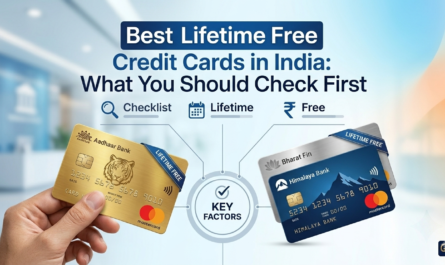
Lifetime-free cards can be useful for people who want to avoid annual fees.
However, “lifetime free” generally refers to the annual or renewal fee. Other charges can still apply, including foreign transaction fees, cash withdrawal charges, late payment charges, or other service fees.
If your spending is moderate and you do not need premium benefits, a lifetime-free card can be a practical choice.
Reward Credit Cards
Traditional reward cards provide points for eligible transactions.
The important thing is to calculate the real value of those points.
Check:
- How many points you earn
- Which purchases qualify
- Redemption value
- Redemption options
- Minimum redemption amount
- Expiry rules
- Redemption fees
- Reward caps
A high number of reward points does not necessarily mean high value.
What About Bank Accounts?
Choosing a bank account requires a different approach.
For most people, a savings account should be easy to operate, reasonably priced, and supported by reliable digital banking services.
Important factors include:
- Savings interest rate
- Minimum balance requirement
- ATM availability
- Debit card charges
- Online banking
- Mobile banking
- UPI support
- Transaction limits
- Service charges
- Customer support
A higher interest rate can be attractive, but it should not be the only factor.
Savings Account Interest Rates
The interest rate on a savings account determines how much you can earn on eligible balances.
Rates vary between banks and account types. Some smaller or digital-focused banks may offer higher rates than traditional large banks, but customers should also consider the bank’s services, accessibility, conditions, and overall suitability.
Interest rates can change, so always check the current rate before opening an account.
For comparison, recent August 2026 reporting shows that deposit rates in India continue to vary significantly across banks and products, with some banks offering higher rates on fixed deposits than ordinary savings accounts.
If your main goal is earning interest on money you do not need immediately, compare savings accounts with appropriate deposit products rather than assuming a normal savings account will provide the highest return.
Minimum Balance Requirements
Some savings accounts require customers to maintain a particular balance.
If the balance falls below the required level, applicable charges may be imposed depending on the account’s terms.
Before opening an account, ask:
How much money do I need to keep in this account?
If you prefer not to maintain a specific balance, look for an account designed without such a requirement, subject to the bank’s current terms.
Banking Fees Matter
Banking charges can reduce the value of an otherwise attractive account.
Check for:
- Debit card annual charges
- ATM charges
- Cheque book fees
- Cash deposit charges
- Account service charges
- International transaction fees
- SMS or other notification charges
- Minimum balance-related charges
Do not compare accounts only by their interest rate. A slightly higher rate may not be valuable if you regularly pay unnecessary service fees.
Credit Card Fees Matter Too
The same principle applies to credit cards.
A card with a ₹5,000 annual fee can be better than a lifetime-free card if you receive more than ₹5,000 in genuine value from its rewards and benefits.
For example:
Rewards + usable benefits − annual fee = approximate net value
Suppose a card gives you ₹7,000 of realistic annual value and costs ₹3,000.
Your approximate net benefit would be ₹4,000.
But if you rarely use the card’s travel or lounge benefits, the calculation can change significantly.
Don’t Ignore Credit Card Interest
Credit card interest is one of the most important costs to understand.
If you pay your total outstanding balance by the due date, you can generally avoid finance charges on eligible purchases according to the card’s terms.
If you carry a balance, however, interest and other applicable charges can make credit expensive.
This is why a card with excellent rewards is not automatically a good financial choice for someone who regularly carries unpaid balances.
Rewards should never be an excuse to spend beyond your ability to repay.
Compare Foreign Transaction Charges
International travelers should pay particular attention to foreign currency charges.
A card may provide strong domestic rewards but have a relatively high foreign transaction markup.
Before using a card internationally, compare:
- Foreign currency markup
- Currency conversion terms
- International rewards
- Lounge access
- Travel-related benefits
The lowest annual fee does not necessarily mean the lowest overall cost.
Consider Your Spending Pattern
Your monthly spending should guide your credit card choice.
For example:
Online shopper: Consider cashback or shopping-focused rewards.
Frequent traveler: Look at travel rewards, lounge access, and transfer partners.
Fuel user: Compare fuel-related benefits and applicable surcharge policies.
Low spender: A lifetime-free card may be more practical.
High spender: A premium card may provide greater value if you can use its milestones and benefits.
Beginner: Focus on simple rewards, manageable fees, and responsible repayment rather than premium features.
Which Bank Account Is Best for You?
The best bank account also depends on your situation.
For Everyday Banking
Look for convenient UPI, mobile banking, ATM access, low charges, and a manageable balance requirement.
For Saving Money
Compare savings interest rates, balance requirements, withdrawal rules, and overall account charges.
For Digital Banking
Focus on app quality, UPI functionality, online services, security features, and customer support.
For Frequent International Travelers
Look at international debit card acceptance, foreign transaction charges, ATM availability, and other applicable fees.
A Simple Comparison Method
Before choosing a product, make a small comparison.
| Factor | Card/Account A | Card/Account B |
| Annual/Service Fee | ₹0 | ₹2,500 |
| Expected Rewards/Interest | ₹2,000 | ₹5,000 |
| Other Useful Benefits | ₹500 | ₹2,000 |
| Expected Cost | ₹0 | ₹2,500 |
| Approx. Net Value | ₹2,500 | ₹4,500 |
This type of calculation can help you avoid choosing a product simply because it has a low fee.
The figures should be based on your realistic usage, not the maximum advertised benefits.
Common Mistakes to Avoid
Many customers make financial product decisions based only on advertisements.
Try to avoid:
- Choosing a credit card only because of a high reward rate
- Ignoring annual fees
- Spending extra to unlock rewards
- Paying only the minimum credit card amount
- Ignoring foreign transaction charges
- Opening a bank account without checking balance requirements
- Choosing a savings account solely because of its interest rate
- Applying for multiple credit cards unnecessarily
- Ignoring the official terms and conditions
A financial product should make your money management easier, not more complicated.
Frequently Asked Questions
Which is better, a lifetime-free or paid credit card?
It depends on your spending. A lifetime-free card can be better for low or moderate users, while a paid card may provide more value to people who use its rewards and premium benefits.
Which bank account gives the highest interest?
Interest rates vary by bank, account type, balance, and time. Check current rates directly with the bank because they can change.
Is a credit card better than a debit card?
They serve different purposes. A credit card uses a line of credit and can provide rewards, while a debit card generally uses money already available in your bank account.
Should I choose rewards or cashback?
Cashback is usually simpler to understand. Reward points can sometimes provide greater value when redeemed strategically. Compare the actual value based on your spending.
Is a high-interest savings account always better?
No. Also consider fees, minimum balance requirements, digital banking services, accessibility, and the conditions attached to the advertised interest rate.
Final Thoughts
Choosing the best credit card or bank account in India is not about finding one product that is perfect for everyone.
The better approach is to compare fees, rewards, interest rates, conditions, and practical benefits against your own financial habits.
For credit cards, focus on annual fees, reward value, cashback limits, interest charges, lounge benefits, and foreign transaction costs. For bank accounts, compare savings interest, minimum balance requirements, ATM and service charges, digital banking, and accessibility.
Current market comparisons show a wide range of Indian credit cards, from lifetime-free options to premium cards with five-figure annual fees, so there is no reason to pay for benefits you will not use.
The smartest choice is the product that gives you useful value at a reasonable overall cost.
Most importantly, read the latest official fee schedule and product terms before applying or opening an account. Rates, rewards, eligibility requirements, and benefits can change over time.
Guide Nobbe provides general financial information for educational purposes only. This article is not personalized financial advice. Always verify current fees, interest rates, rewards, eligibility requirements, and other terms directly with the relevant bank or card issuer before making a financial decision.